Posts

Reflections on the 2019 - 2020 School Year
Image
As our 2019 - 2020 school year came to a close last week, I've started to reflect on all of the changes and transformations that took place. In the summer of 2019, I welcomed my second daughter into the world and really grew as a mother during my maternity leave this fall. When I returned in the winter, I was excited to continue my work as our district STEAM Innovation Coach. January and February were filled with moments of impact, but perhaps nothing quite as transformative as what March had in store. I'll never forget the day of Friday, March 13th, 2020. My colleagues and I had spent that morning teaching 8th grade social studies classes and were coming together to debrief the lessons during lunch. The governor had just announced that due to COVID-19, schools would be closed for the next three weeks and that would lead into our spring break, making it four weeks. We had so many questions of what would happen over the next three weeks: Would we be coming into the office? What ...

Ikigai - Finding Your Purpose

Image
I had the privilege of teaching overseas in Okinawa for the first two years of my career. While I was there, a lot of scientists around the world were trying to figure out why Okinawa had one of the highest percentages of people who were living up to or past 100, Centenerians. One of the early theories was the "Okinawan Diet" that it was made up primarily of local vegetables and fresh fish. In recent years, there has been more research around the concept of Ikigai ( 生き甲斐 in Japanese).  Ikigai is roughly translated into "a reason for being" or knowing your purpose. When what you love, what the world needs, what you can be paid for, and what you are good at intersects, that is your Ikigai. Looking at the diagram below, when you are missing the characteristics of one of these categories, it can lead to unfulfillment. For example, if you are missing "what the world needs", it can lead to satisfaction, but a feeling of uselessness. So the ultimate goal to dis...

Campbell Family Code Night 2017

Image
We held our first ever Campbell Family Code Night last week at Rosemary! We had over 100 CUSD families sign up to explore and learn how to code together! It was so exciting to join this nationwide movement to engage all families in learning computer science. We were so fortunate to be about to collaborate with School Linked Services and Measure A to provide funding for this event. Thank you to Casey Agena from the Santa Clara County Office of Education STEAM Team for being our coding facilitator! If you would like to host your own Family Code Night, download your own event kit here:  www.familycodenight.org/ All families also got to create a Lectrify circuit bracelet to remind them of the spark for learning together that was started on Family Code Night!

Appreciating Variability

Image
Universal Design for Learning, discusses ways to recognize variability as an asset, and not a liability. The strategic networks of the brain are mentioned and their connection to The Marshmallow Test. In this test of instant gratification, young students are given a marshmallow. They are told that they can eat the marshmallow now, or if they wait, they can have two when the teacher comes back. It is interesting to see the different strategies the students use to try to help themselves in this experiment. Another strategy that we can teach our kids is a "positive time-out". Usually, time-outs are used as a form of punishment. But it is more powerful, if we teach our kids to use them as a time to self-reflect and self-regulate. Instead of waiting for problems to arise, we must help our kids self-monitor and to recognize when they need a break. One of the first steps in doing so is helping them to see patterns in when they are getting upset and to understand what triggers them...

Developing Expert Learners

Image
The purpose of learning is not to get good grades. The purpose is to be an expert learner.  What does it mean to be an expert learner? Katie Novak defines expert learners as, "knowledgeable and resourceful, purposeful and motivated, self-directed and strategic."  In schools today, we don't always give students enough opportunities to practice becoming an expert learner. We often tell students what the final product should be or give them the resources they need. What needs to change in my practice if I want to support teachers as they transform education so all students become expert learners?  First, we need to create environments where it is okay to take risks and to fail.  Second, we need to be flexible and allow our students and teachers to make choices. If there is no flexibility, how will people be self-directed? Finally,  we need to celebrate the risk-taking and resiliency of our students and teachers to keep trying to constantly transform education. ...

Universal Design For Learning and STEAM

Image
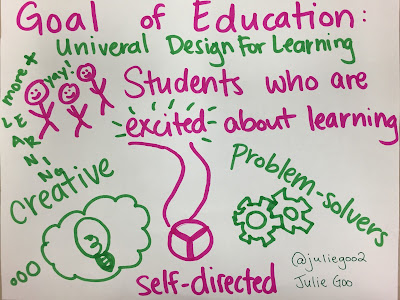
I just started taking a course on UDL (Universal Design for Learning) with a few of my colleagues. The more I learn about UDL, the more I see the connections between UDL and STEAM.  One of the main goals of UDL is to foster self-directed, creative learners. One of the ways that we are able to encourage our students to be more self-directed is to encourage a love of learning from an early age. How are we already doing this? In many of our classes, students are given more choices in how they want to learn, collaborate with classmates, and how they want to share their knowledge. Some of our teachers are facilitating Genius Hour, to allow our students to discover their passions, learn about them, and teach others about it. In order to graduate, all of our eighth graders must complete an Exhibition project. This project has evolved over the years. In its current version, students have the option of working with a partner to find a problem that is relevant in their lives. They then...

Campbell Union School District's STEAM Innovation Leaders

Image
  Introducing Campbell Union School District's first STEAM Innovation Teacher Leader cohort!  Blackford Elementary School - May Liu Capri Elementary School - Gloria McGriff and Teresa Iden Castlemont Elementary School - Jisung Chong Forest Hill Elementary School - Julie Hart Lynhaven Elementary School - Megan Delaye Rosemary Elementary School - Jessica Branstetter Sherman Oaks Elementary School - Lino Gutierrez Marshall Lane Elementary School - Michelle Beddo Village Elementary School - Elizabeth Shepherd Campbell Middle School - Kimiyo Cordero Monroe Middle School - Anthoney Roe Rolling Hills Middle School - Carrie Tibbs These 13 innovative teacher leaders have been selected to lead and continue to develop our district's STEAM program. Their first group challenge, to come up with a few Back To School Ideas that teachers in their grade level could use to start their year in a STEAMy way! Read about the ideas that we designed that day on  RAFT Ed...

Spring 2017

Image
As the school year has come to a close, I wanted to reflect on a few of the successes of last school year. Our 9 elementary schools have created their own school STEAM Space or STEAM Centers. And our 3 middle schools have STEAM resources in their libraries. I can't wait to work with our school leadership teams to help them develop a plan to provide meaningful STEAM experiences for every student! I didn't really get to blog last year, so my new goal for this school year is to blog once a week!

Piper Kits

Image
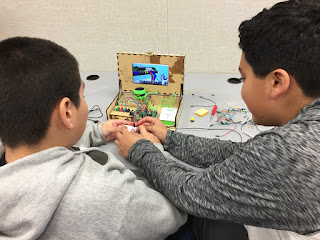
I'm back from my maternity and so excited to be back in the swing of things! This year we have a new (part-time) STEAM TOSA, Sherry Burch, and I am thrilled to have partner to collaborate with! One of the first projects that we worked on together was a Saturday STEAM Academy class with the Piper Kits! We had gotten the Piper Kits through Donors Choose, with the majority of the funding coming from Groupware. Sherry had her STEAM class build the laser-cut, wooden Piper boxes, which she said was both challenging and fun for the kids, as some of them had never used a screwdriver before. As part of the introductory Minecraft programming lessons in the Piper Kit, students use a Raspberry Pi to build the controls for their computer. They first worked with a partner to connect jumper wires to buttons to be their up, down, left, and right controls. They also problem solved to create circuits operate buzzers, LED lights, and switches to truly bring their computers to life. At the end o...

3rd Grade Dash Robot Life Cycle Exhibition Projects

Image
At Sherman Oaks Elementary School, all students in grades TK - 6 prepare an exhibition project to present to the community at the end of the school year. I was thrilled when 3rd grade teacher, Vanessa Diaz, reached out to me about planning their exhibition project around the 3rd NGSS standard of Life Cycles and incorporating programming with the Dash Robots.  In groups, students researched a plant or animal and the different stages in its life cycle. Each student was then responsible for typing a paragraph about a particular stage in the life cycle in Spanish or English (since Sherman Oaks is a Spanish immersion school). Students then worked with their teams to create a poster to organize the stages of their life cycle. We asked them to map out at least six different stopping points for Dash to stop and teach others about that particular stage.  When programming, we also challenged students to have Dash always facing the audience when he is saying something. This ...

3D Modeling and Printing Training, Bicycle Helmets, and Gold Rush Tools

Image
We recently had four 3D modeling and printing trainings in our district to build interest and expertise around manufacturing and design. We had over 80 teachers, technicians, librarians, and parents throughout the district participate! The trainings were facilitated by myself and Sam Patterson, Technology Integration Specialist at Gideon Hausner Jewish Day School. During the training, we focused on using TinkerCAD and the Polar 3D Cloud. You can view resources from our training by: Clicking Here  We also encouraged teachers to think about a project that they are currently working on and how they can incorporate 3D modeling and design. I also created several screencasts that teachers could use with their own classes to get started with 3D modeling: As a follow-up, two of the classrooms that I've recently worked with are Anne Stephano's 2nd grade class and Brian Tamekuni's 4th grade class. The second graders had been learning about bicycle safety, so we had them use Tink...

2nd Grade NGSS Mystery Science Materials Unit at Sherman Oaks

Image
The 2nd graders at Sherman Oaks Elementary school are hard at work learning about materials and their properties, one of their new NGSS performance expectations! Their teacher, Maria Guevara, is one of our new NGSS Teacher Leaders, and invited me to try out a Mystery Science Lesson with her. All 2nd - 5th grade units are currently available for a free trial on  https://mysteryscience.com/  K - 1st grade units should also be available in the fall. The students started by watching a few short videos and discussing the guiding question: Why do we wear clothes? Students were introduced to different material properties like, light, heavy, hard, soft, stretch, and staff. Students were then given the challenge of designing a hat using different materials. They first tested all of the materials for softness, stiffness, and sweat-soaking (water). They then used what they had learned about each material to design and create a hat that they could wear outside. We added that they s...

4th Grade 3D Printing Jewelry Factory at Blackford

Image
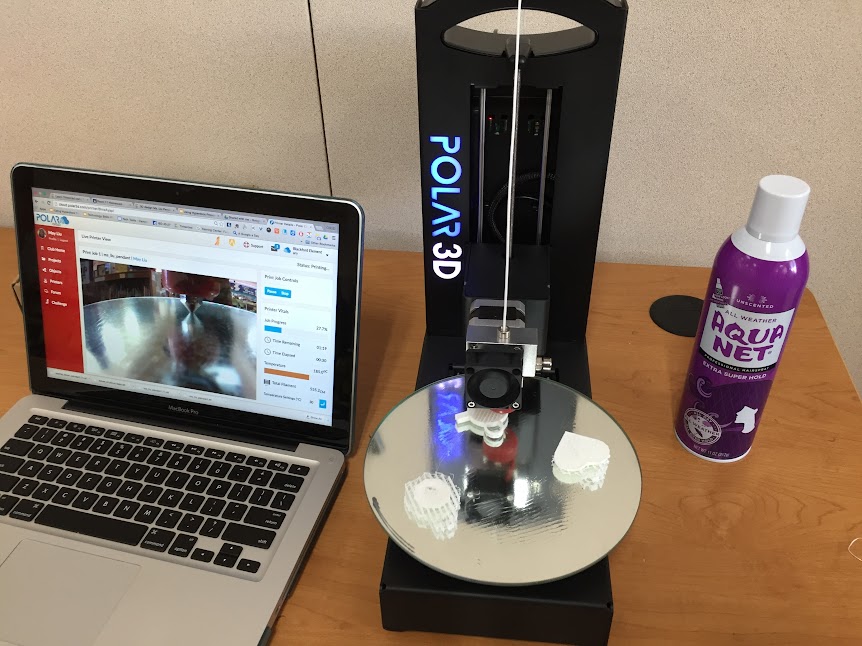
Our 4th graders at Blackford Elementary School have been busy starting their 3D jewelry design and printing factory! 4th grade teacher, May Liu, was part of our 2015 Advanced STEAM Cohort and was excited to work on a project with Blackford's new 3D printer. We recently purchased a Polar 3D printer for all of our elementary and middle schools through a K - 16 Manufacturing Grant that we are part of with our local high school and community community college. We selected the Polar 3D because of its ability to send prints wirelessly through the Polar Cloud (great for sharing with multiple classes), its included live video capabilities, the ease of preparing the build plate (only a layer of hair spray is needed), the safety and environmental impact of using recycled PLA filament, and its relatively low cost of $599 (with educational pricing). We first had students do the first three self-paced tutorials on TinkerCAD.com (using their district Google Accounts to sign in) with their Chro...

8th Grade NGSS Project-Based Learning "Science Behind the Music" Unit

Image
Josh Pizzica and Anne Sanderfer, 8th grade teachers at Monroe Middle School just created and facilitated their first NGSS Project-Based Learning Unit! Their unit on Waves and Musical Instruments allowed students to discover frequency, pitch, amplitude, and how sound waves travel in an authentic way. The entry event was having a San Jose State University visit their classes to bring musical instruments and to allow students to see how particular instruments were engineered and created different sounds. Students then had about 3 weeks to choose and build their own instruments out of recycled materials. This also gave students a hands-on experience using woodworking tools like saws, drills, and hammers. With their groups, students also created a presentation to teach others about their instrument and the "science behind how it works" at their Musical Showcase. Magnificent work Anne, Josh, and your musical 8th graders!

3rd Grade Dash Robot Polygon Party at Marshall Lane

Image
As part of their geometry unit, the 3rd graders at Marshall Lane Elementary School have been learning about polygons and angles. Teacher, Meghan Snelham, incorporated the Dash robots by having her students create giant polygons on the floor using blue painters tape. In teams of 2 - 3 students, students drew a model of a polygon, labeled each side, calculated the perimeter, and came up with at least four facts about it. They then used painters tape, rulers, and protractors to create their polygon on the classroom floor. Students then began programming the Dash robots to travel along the perimeter of their shape and to say a fact at each corner. It was really interesting to see them problem solve with their partners how to measure the angles that they had created, in order to be able to program Dash to turn that many degrees to the left or right. Students also had to measure the polygon sides accurately so that Dash could travel along each side.  Students also...

CUE STEAMPunk Flying Drones Land in Campbell Union School District!

Image
I was so excited when the CUE STEAMPunk Drone Suitcase arrived in Campbell! I had heard about these awesome Parrot Flying Drones, but had never actually used one. Thanks to the CUE STEAMPunk Mobile Labs and Parrot, we were able to test four of them out for FREE! Before they arrived, I began planning which schools I would use them with and which content areas they could be best integrated with. Thanks to CUE STEAMPunk Teacher Advisor, Brian Briggs, I was able to quickly find a few lesson ideas on his Drone Academy:  http://rockstardrone.weebly.com/ With our STEAM students at Monroe Middle School, we had them start with Mission 1: Speed and Distance. Students used the Tickle App to predict and measure the different distances that Parrot would travel, when adjusting the time and speed. It was amazing to watch the students eyes light up in both fear and excitement as they programmed the drones to take off for the first time! Next, I took the drones to visit the students at Cas...